
National Metrology Institute of Pakistan

The Chemical Metrology Division (CMD) is responsible for developing and applying techniques regarding qualitative and quantitative measurements in the field of chemistry. Its objective is to establish the National Chemical Metrology Infrastructure and extend the chemical metrology capabilities in NMIP. It is contributing in the research and development (R&D) activities of the NMIP with full zeal and zest in the research areas of chemical analysis, chemical metrology to cater the need of industrial sector in Pakistan and other such technologies. Apart from R & D activities, CMD is also providing analytical services to Public and Private sector customers. The Laboratories of CMD are committed to render reliable services to its customers in accordance with ISO/IEC 17025 standard, other National/ International, customer specific standards and good professional practices with continual improvement in system and services. The division focuses on inorganic and organic analyses covering water/ waste water, food, minerals, ores, metals/ alloys, chemicals and environmental testing.
The functions of the CMD, NMIP are as under:
1. Dissemination / facilitation of testing, analysis and calibration (on-site/in-house) services to public and private sector organizations
2. Water Analysis and water pollution monitoring
3. Environmental impact assessment
4. Consultancy regarding ISO/IEC 17025 in Chemical Metrology
5. Sustainability of highest accuracy / precision in Chemical Metrology through external and internal quality controls (Participation in ILC/PT programs at National and International level)
6. Imparting technical training to personnel from public and private sector organizations in different areas of Chemical Metrology
7. Carrying out R&D activities to cater for the needs of industrial sector of Pakistan in the field of Chemical Metrology
At present, CMD, NMIP consists of the following five sections/labs:
1. Analytical and Spectroscopic Measurement Laboratory
2. Water Testing Laboratory
3. General Material Testing (GMT) Laboratory
4. XRF Laboratory
5. Noise and Air Analysis Laboratory
Analytical Chemistry comprised of classical-wet chemical methods and modern-instrumental methods.
These studies involve the instruments and techniques/methods used to separate, identify,
and quantify matter. In actual fact, separation, identification or quantification may constitute the entire
analysis or be combined with another method. Separation isolates while qualitative analysis identifies
analyte; whereas quantitative analysis determines the concentration or numerical amount. Moreover, the
facility of determination of brix and refractive index along with calibration of refractometer is also in scope
of this laboratory.
The Analytical and spectroscopic measurement laboratory of CMD is an ISO/IEC-17025 accredited
laboratory providing testing and calibration services using instruments like Atomic Absorption
Spectrometer, UV-visible Spectrophotometer and Flame photometer.
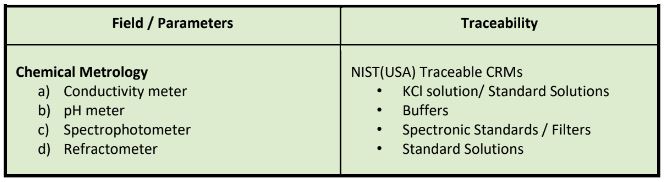
Water testing Laboratory is an ISO/IEC-17025 accredited laboratory of CMD. This laboratory provides testing services for different physical and chemical parameters in the analyses of water, wastewater and different solutions. It has also extended its services in calibration of different equipment / instrument related to water and wastewater testing e.g. Conductivity meter, pH meter, TDS meter etc. This lab provides services to reputable customers involved in fields of a wide variety of applications: agriculture, wastewater treatment, industrial processes, environmental monitoring, and research and development.
General Material Testing Laboratory of CMD renders the testing services of various materials, especially of inorganic nature, to the customer’s utmost satisfaction. Both Quantitative and Qualitative analysis of different traded materials can be performed at GMT Lab. Using the different standard methods and state of the art analytical equipment like continuum source AAS, CS analyzer, calorimeter etc. the quality of different products is also being tested against the various standard methods.
XRF lab is equipped with state-of-the-art Wavelength-Dispersive X-Ray Fluorescence (WD-XRF) Spectrometer which is used to determine the elemental composition of materials. It is a non- destructive analytical technique which is giving indispensable information about materials in the field of metallurgy, materials science, geology and environmental science. XRF Lab is registered with PNRA, is a licensed radiation facility and following safety protocols to prevent workers from harmful effects of ionizing radiation. WD-XRF Spectrometer is providing high resolution (from 0.1 ppm to 100 %) elemental analysis, and simultaneously detecting and quantifying multi-elements within a single sample.
The laboratory has requisite instruments to measure ambient air quality and noise. The lab has qualified and committed staff to provide analytical services timely to its customers.
• X-Ray Fluorescence (XRF) Spectrometer (Zetium, Malvern Panalytical, Neitherlands)
• Atomic Absorption Spectrophotometer (Perkin Elmer, AAnalyst 100)
• Atomic Absorption Spectrophotometer (ContrAA, Analytik Jena)
• Elemental (C&S) Analyzer
• UV/visible Spectrophotometer
• Flame Photometer
• Microwave Digester
• BOD Apparatus
• Conductivity Meter
• pH Meter
• Bomb Calorimeter
• Turbidity Meter
• Dissolved Oxygen Meter
• Refractometer / Brixometer
• Flue Gas Analyzer
• Particulate Matter Analyzer
• Vehicular Emission Analyzer
• Smoke Meter
• Lux Meter
• Lux Meter
The scope of CMD includes both testing and calibration services. These analytical services are further divided in two categories i.e. ISO/IEC 17025 accredited and non-accredited.
a) ISO/IEC 17025 Accredited
1. Analysis of Pb, Zn, Fe, Cd, Cr, Na, K, Mg, Ca, Mn, Co, Ni, Cu in Waters/ waste waters/ Industrial effluents/ solutions using AAS
2. Physico-chemical analysis (pH, Conductivity, Chloride, Total Hardness, Total dissolved solids, Total suspended solids, Alkalinity, COD) of waters / waste waters
1. XRF testing of materials for elemental composition
2. Water Analysis [Arsenic, Nitrite, Nitrate, Oil and grease, pH, Phosphate, Sulfate, Total solids, Turbidity, Biological oxygen demand (BOD), Dissolved Oxygen (DO)]
3. Analysis of Cement, Inorganic Salts, Ores and Minerals, Chiller Solutions, Metals and Alloys, Fertilizer, Industrial Chemicals, Coal, Solvents/solutions, Runway Sealant, Plants/herbs, Soil and Sand
4. Analysis of Al, Mo, Sn and Ba in solutions using AAS (Nitrous Oxide-Acetylene flame)
5. Analysis of Pb, Zn, Fe, Cd, Cr, Na, K, Mg, Ca, Mn, Co, Ni, Cu in minerals, ores, chemicals, fertilizers, soil, foods, food items and confectioneries, metal wires and sheets, chiller solutions, inject able etc. using AAS.
6. Analysis of precious metals viz., Au, Ag, Pt in soils and rocks using AAS
7. Brix, Refractive Index, Specific Gravity of materials
8. Chemical analysis of rock salt
9. Particulate matter (PM2.5, PM10)
10. Industrial emission testing (CO, NOx, SOx)
11. Testing of Vehicle emission
12. Noise and light measurement
a) ISO/IEC 17025 Accredited
1. Conductivity Meter
2. pH Meter calibration using NIST Traceable Standard solutions
a) ISO/IEC 17025 Accredited
1. UV-Visible Spectrophotometers using spectronic standards (Filters)
2. AAS using NIST Traceable Standard solutions
3. Flame Photometer using NIST traceable standard solutions
4. DO Meter
5. TDS Meter
6. Refractometer
7. Brix-meter