National Metrology Institute of Pakistan

The metrology of thermal properties, which is more recent than that of length and mass, coincides with the creation of thermometers and the implementation of the temperature scales. The first major contributions to the study of thermal properties can be attributed to Franklin who devised in 1780 an experiment to evaluate the relative capacities of thermal conduction of different materials. It was not until 1807 that the first determination of an absolute value of thermal conductivity was done by Fourier. The experimental discovery of Joule around 1860, concerning the relationship between the heat generated and current flowing through a conductor, was the next important contribution to the development of metrology of thermal properties, as it provided for the first time the possibility of producing a known amount of heat by electrical way.
Energy can come in many forms, and it can change from one form to another but can never be lost. This is the First Law of Thermodynamics. A byproduct of nearly all energy conversion is heat, which is also known as thermal energy. When there is a temperature difference between two objects or two areas within the same object, heat transfer occurs. Heat energy transfers from the warmer areas to the cooler areas until thermal equilibrium is reached. This is the Second Law of Thermodynamics. When the temperature of an object is the same as the surrounding environment, it is said to be at ambienttemperature.
Thermal energy transfer occurs through three mechanisms: conduction, convection, and/or radiation. Conduction occurs primarily in solids and to a lesser degree in fluids as warmer, more energetic molecules transfer their energy to cooler adjacent molecules.
Convection occurs in liquids and gases, and involves the mass movement of molecules such as when stirring or mixing is involved.
The third way that heat is transferred is through electromagnetic radiation of energy. Radiationneeds no medium to flow through and, therefore, can occur even in a vacuum. Electromagnetic radiation is produced when electrons lose energy and fall to a lower energy state.Boththe wavelength and intensity of the radiation is directly related to the temperature of the surface molecules or atoms.
When two bodies are in Thermal contact with each other, heat flows from a hot body to cold body. Therefor temperature is that property of a body Which determines the direction of flow of heat.
Temperature is also defined as the degree of hotness or coldness of a body.
The Kelvin is a unit of measure for temperature as it is also measured in Fahrenheit (F) and Celsius(C). It is one of the seven base units in the International System of Units (SI) and is assigned the unit symbol K.The kelvin is defined as the fraction 1⁄273.16 of the thermodynamic temperature of the triple point of water (exactly 0.01 °C or 32.018 °F). In other words, it is defined such that the triple point of water is exactly 273.16 K.
• Maintenance, dissemination/ facilitation of testing, and calibration (on-site/in-house) services to public and private sector organizations.
• Consultancy regarding ISO-17025 in Thermal Metrology.
• Maintaining highest accuracy in Thermal metrology through fixed point Calibrations.
• Imparting technical training to personnel from public & private sector organizations in different areas of Thermal metrology.
• Carrying out R&D activities to cater the needs of industrial sector in the field of Thermal metrology.
• Participation in ILC/PT programs at National and International level as per ISO 17025/2017.
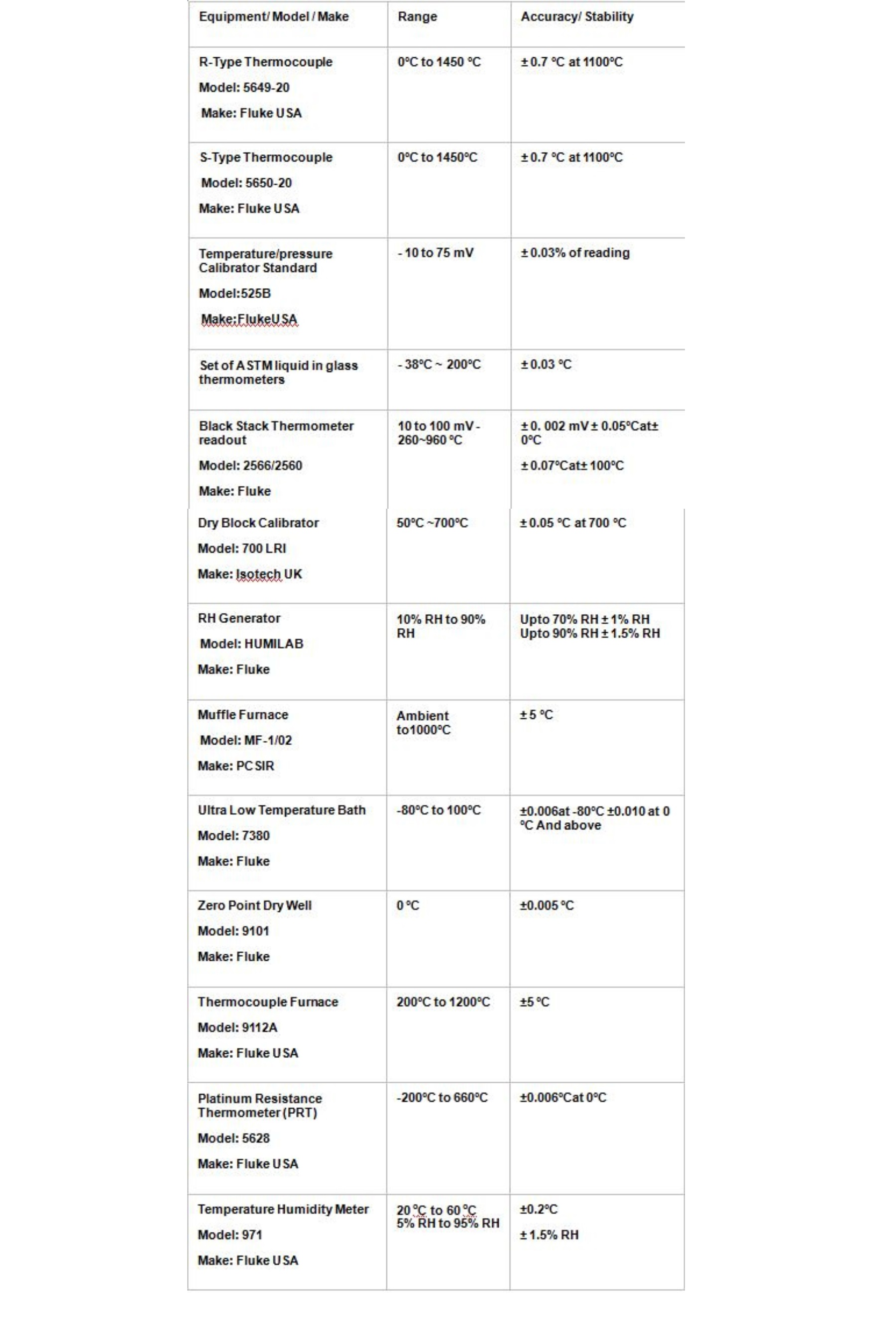
Thermal Metrology Division (TMD) has the following facilities
• Liquid in Glass Thermometry
• Thermocouple Pyrometer
• Resistance Thermometry
• Thermohygrometry
• Heat sources
• All thermocouple types(J,K,R,T,S,N,B,etc.),PRT types(PT-100,RTD etc.),mv(millivolts) through simulation method
• Thermocouples Types (J,K,T,E,R,S,N,B)
• Thermo hygrometers
• Drywell Calibrators
• Furnaces
• Ovens
• Incubators
• Water baths
• Temperature Calibrators